
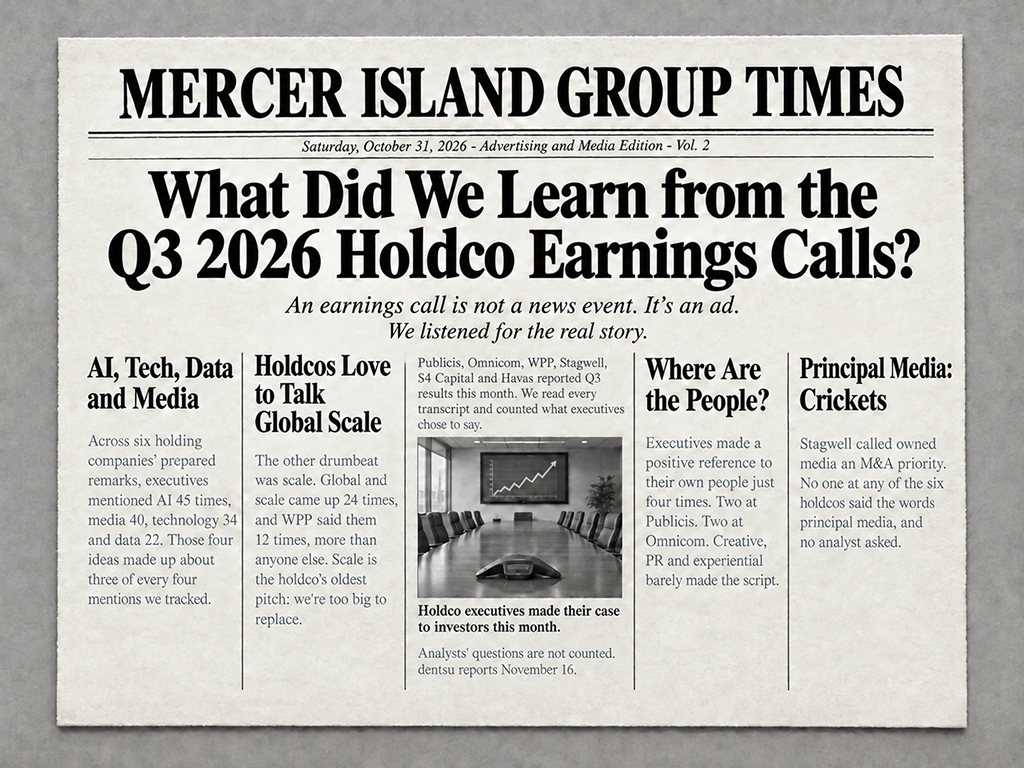
Earnings calls offer a special, brief glimpse into a public company.
But remember, an earnings call is not a news event. It’s an ad.
The audience isn’t clients or employees. It’s the money markets: the analysts, fund managers and shareholders who decide what a holding company’s stock is worth. Every word in the prepared remarks has been drafted, lawyered and rehearsed to tell investors one thing: we know where our industry’s growth is, and we’re going to get there first.
So if you want to know what the holdcos think investors want to hear, read the scripts. Better yet, count the words.
That’s what we did.
Six holding companies reported Q3 2026 results this month: Publicis, Omnicom (now including IPG), WPP, Stagwell, S4 Capital and Havas. WPP and S4 held trading-update calls rather than full earnings calls. dentsu reports November 16.
We listened closely to their “commercials”.
The calls
We read every transcript and counted how many times the executives (CEOs, CFOs and investor-relations heads opening the calls) mentioned a set of key ideas in their prepared remarks. That’s the part of the call that’s fully scripted, before the analysts get to ask anything.
What they talked about: AI, tech, data and media
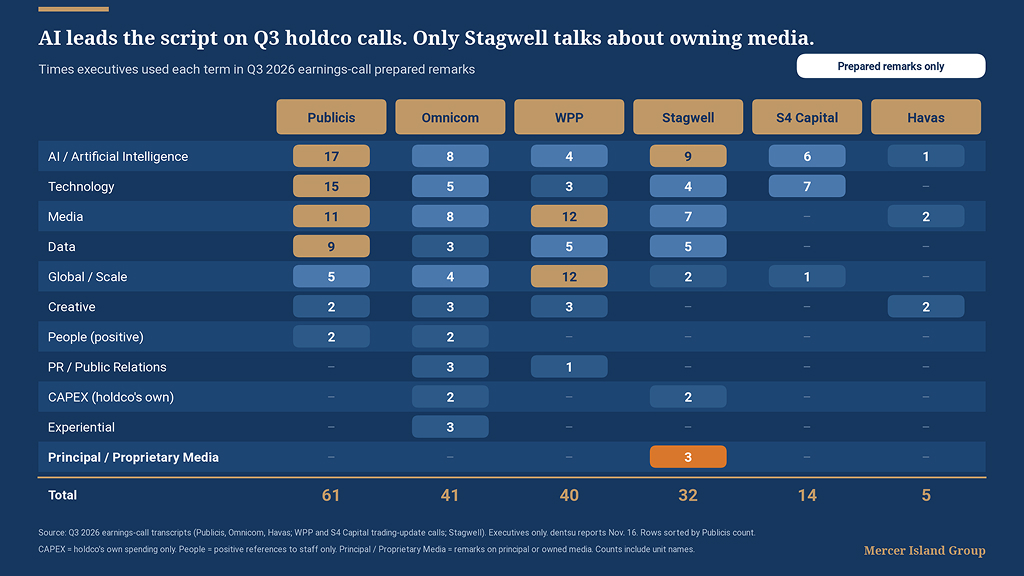
Across the six prepared scripts, the executives mentioned:
- AI 45 times
- Media 40 times
- Technology 34 times
- Data 22 times
Those four ideas account for about three of every four mentions we tracked. Publicis led on AI (17), technology (15) and data (9). WPP led on media (12).
No surprise. AI is the story the market is buying, and every holdco wants to be the one that turns AI into margin rather than the one disrupted by it. Media is where the money is.
Global scale: WPP leads the way
The other drumbeat was scale. “Global” and “scale” came up 24 times, and WPP said them 12 times, more than anyone else and exactly as often as it said “media.”
For a company in the middle of a reset, that makes sense. Scale is the holdco’s oldest pitch: we’re too big to replace.
What they didn't talk about: their people
Here’s the number that should bother anyone who works at, or with, an agency.
Across all six prepared scripts, executives made a positive reference to their own people (thanking them, investing in them, valuing them) exactly four times. Two at Publicis. Two at Omnicom. Zero at WPP, Stagwell, S4 or Havas.
When “people” did come up, it was often in a different context. “Our planned people actions are mostly behind us” is how Omnicom described the job cuts that followed the IPG merger. Another cited “people cost as a percentage of net revenue” as a sign that AI is working.
In a business whose product is still made by people, that’s a telling silence. To these Holdcos and their investors, people are a cost line.
What else was rarely mentioned? Creative. PR. Experiential. CAPEX.
The rest of the agency business barely made the script:
- Creative: 10 mentions across six companies
- PR: 4, nearly all from Omnicom
- Experiential: 3, all from Omnicom
- The holdcos’ own capital expenditures: 4, from Omnicom and Stagwell
Every holdco says it’s investing heavily in AI. Hardly anyone talked about what they’re spending to build it.
What only Stagwell mentioned: owning the media
One idea showed up in exactly one script. Stagwell’s Mark Penn told investors that “owned media is an M&A priority because we see synergistic high-margin opportunities with our core businesses.” He pointed to Stagwell’s increased investment in RealClearPolitics and its acquisition of Freestar, an ad-operations platform serving more than 1,000 publisher websites, as giving Stagwell a “direct media pipeline for our clients.”
That’s principal media’s close cousin: the agency owning, or controlling, the inventory it recommends. Stagwell mentioned it three times in its prepared remarks. Every other holdco: zero.
And nobody, at any of the six companies, said the words “principal media.”
What happened when then the analysts got involved?
Not much changed.
Once the Q&A started, the conversation was mostly more of the same. Add the Q&A and media narrowly edges past AI as the most-mentioned idea. Technology and data follow.
The one difference was creative. The analysts were curious about it, especially at WPP, where they kept circling back to creative performance, and at Stagwell, where Goldman Sachs asked whether weakness in creative was structural or just timing. Creative mentions by WPP’s executives jumped from 3 in the script to 17 by the end of the call.
What did the analysts not ask about?
Principal media.
Not one analyst on any of the six calls asked about it. The closest anyone came was a single question to Stagwell about its owned-media strategy and how it would avoid channel conflict.
That’s remarkable. Forrester predicts that principal media will grow to one-third of total media billings in 2026, and calls it “a business necessity for advertisers and partners under budget and revenue pressure.” Not everyone (including the Mercer Island Group team) agrees with that estimate. And we certainly aren’t buying the story that principal media is a business necessity for advertisers and agencies.
MediaCat argues the real share is closer to 10%. But even at 10%, principal media is one of the most consequential profit levers in the Holdco business.
And yet, in six earnings calls, it wasn’t important enough to ask or talk about.
What does this mean for marketers?
Watch what they do, not what they say.
Earnings calls tell you what the holdcos want investors to believe. AI, technology, data, media and scale are the story.
They also tell you what the holdcos would rather not discuss. Their people. Their creative product. How they actually make money buying and reselling media.
If you’re a marketer, the second list is the one to bring to your next agency review. Ask how the agency’s creative will be compelling in a world of AI, data and technology. Ask how your agency makes money on your media. Ask what share of your plan is principal-based. Ask who the people on your business are, and whether they’ll still be there next year.
The investors aren’t asking. You should.
Methodology: Mercer Island Group counted executive mentions in Q3 2026 earnings-call transcripts for Publicis, Omnicom, WPP, Stagwell, S4 Capital and Havas (WPP and S4 Capital held trading-update calls). Analyst questions are excluded. “People” counts only positive references to the company’s own staff. CAPEX counts only the holdco’s own capital spending. “Global / Scale” includes global, globally, scale and its forms. Owned/proprietary media counts each executive remark about principal or owned media.
Steve Boehler, founder, and partner at Mercer Island Group has led consulting teams on behalf of clients as diverse as Ulta Beauty, Microsoft, UScellular, Nintendo, Kaiser Permanente, Holland America Line, Stop & Shop, Qualcomm, Brooks Running, and numerous others. He founded MIG after serving as a division president in a Fortune 100 when he was only 32. Earlier in his career, Steve Boehler cut his teeth with a decade in Brand Management at Procter & Gamble, leading brands like Tide, Pringles, and Jif.
Mercer Island Group helps marketers and agencies succeed. Company leadership is as much at home with marketers and their C-Suites as in an agency’s boardroom. With marketers, Mercer Island Group is a top 5 agency search consultancy covering all types of agency relationships (creative, media, web, PR, experiential) and assists marketers with marketing organization structure, workflow and critical skill development (briefing, creative evaluation & feedback, etc.). The company also supports leading and aspiring agencies with positioning, pitch and strategy training and pitch support.