
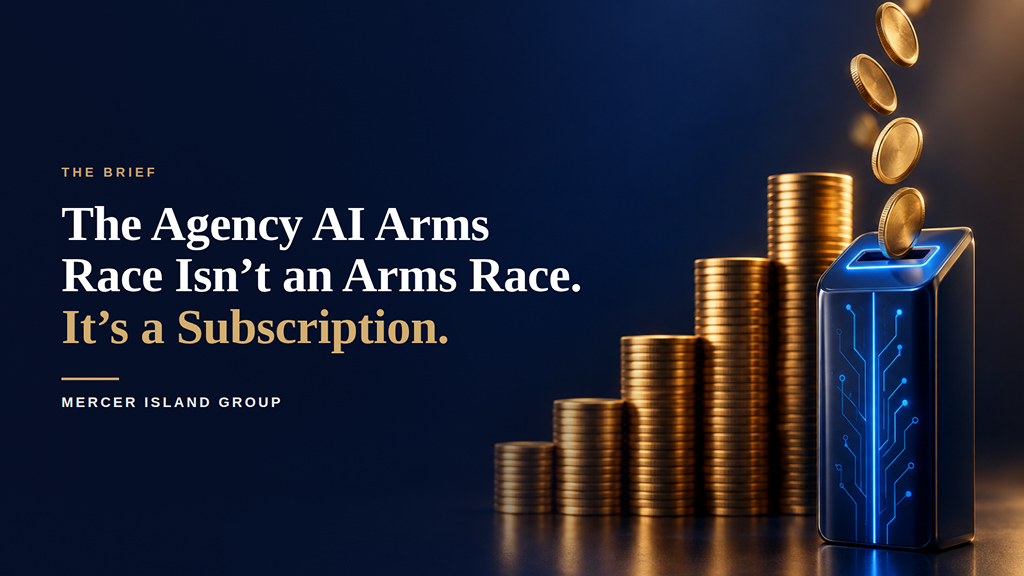
Every holding company is telling clients they are investing hundreds of millions in AI.
WPP: $400 million. Publicis: $326 million over three years, and $15.7 billion over a decade. Havas: $110 million a year. Dentsu: roughly $51 million per year.
Big numbers. Confident numbers. Numbers designed to make an independent agency feel outgunned.
So we went and looked at what they actually spent.
What the balance sheets say
Capital expenditure is the money a company spends on things it owns. Operating expenditure is the money it spends on things it rents.
Here is FY2025 for the public holding companies.
| Company | Capex as % of revenue | Opex as % of revenue | Opex : capex |
|---|---|---|---|
| S4 Capital | 0.62% | 97.2% | 156x |
| Omnicom | 0.87% | 97.4% | 112x |
| Havas | 1.24% | 88.0% | 71x |
| WPP | 1.37% | 97.2% | 71x |
| Publicis | 1.44% | 85.1% | 59x |
| Dentsu | 1.88% | 89.7% | 48x |
| Stagwell | 3.82% | 94.5% | 25x |
Source: FY2025 filings. Omnicom includes IPG post-close. Opex : capex = operating expenses/capital expenditure.
Read that last column again.
For every dollar Omnicom put into an asset it owns, it spent $112 on payroll, rent, freelance, licenses and pass-through costs.
That is not an arms race. That is a service business buying subscriptions.
Are they even replacing the assets they have?
No.
Capex lags depreciation at every single holdco. Omnicom replaced 54% of what depreciated. WPP, 42%. Dentsu, 36%. Publicis, 33%. S4 Capital, 7%.
The whole sector shows the same picture. Damodaran’s January 2026 industry dataset puts advertising at 37.43% capex-to-depreciation across 52 firms, with net capex to sales of negative 1.52% (NYU Stern).
The industry is shrinking its owned asset base while announcing an investment boom.
So where did the AI money go?
Into the P&L. Where “agency investment” always was.
Publicis CFO Loris Nold described the group’s AI cost as “licenses and usage,” with daily caps on what each employee can burn (Digiday).
Licenses and usage. That is a phone bill, not a factory.
There is an accounting reason for this. You cannot capitalize a subscription. Only certain implementation costs qualify.
Which means the holdcos are buying AI the same way your agency buys AI. From the same vendors. On the same terms. Likely at a similar per-seat price.
Stagwell is the one genuine exception, with $67.5 million of capitalized software in 2025. Everyone else is renting.
What about independents?
Here is the uncomfortable part.
There is no public capex benchmark for independent agencies. None.
We checked. The 4A’s 2025 Financial & Operational Benchmarks survey covers 117 agencies, 80% of them independently owned, and does not report capex. The 4A’s Analysis of Agency Costs covers 89 independents across six size bands. No capex line. Promethean Research, SoDA, Second Wind, Parakeeto, RSW/US. Labor, overhead, margin, utilization — none cover capex.
The trade bodies do not ask, because for decades the answer was “a few laptops and some furniture.”
The only audited independent capex we could find sits in UK Company House filings for Brainlabs and Croud. Same story as the holdcos. Asset-light.
How about the consultants?
The consultancies are a worthy comparison as the holdcos use them for benchmarking.
Accenture, FY2025: capex of 0.86% of revenue. That is below Omnicom. And Accenture replaced only 25% of its depreciating asset base.
IBM: 1.62%. Infosys: 1.36%. Cognizant: 1.36%. Capgemini: 1.28%.
Every one of them under-replacing depreciation, exactly like the agencies.
What does real AI investment look like?
Look at the platforms.
Meta: 34.7% of revenue. Microsoft: 22.9%. Alphabet: 22.7%. Amazon: 18.4%.
Meta’s opex-to-capex ratio is 1.7 to 1. Omnicom’s is 112 to 1.
And the replacement figures invert completely. Alphabet spent 433% of depreciation. Meta, 374%. Microsoft, 219%. Amazon, 200%.
That is what building something durable actually looks like.
Fine. But agencies aren't Google.
True. So take the platforms off the table and find a fairer comparison.
The holding companies say they are becoming data and technology companies. Knowledge businesses that own their products. There is already an industry that looks exactly like that: information services.
Thomson Reuters sells legal and tax intelligence. Equifax sells credit data. Verisk sells insurance analytics. Like agencies, they are built on expertise. Unlike agencies, they turned that expertise into owned, recurring products.
Here is what that costs.
| Company | What it sells | Capex as % of revenue |
|---|---|---|
| Thomson Reuters | Legal and tax information | 8.5% |
| Equifax | Credit data and analytics | 7.9% |
| Verisk | Insurance data and analytics | 7.9% |
| Holding companies | Range, excluding Stagwell (3.8%) | 0.6–1.9% |
| Gartner | Research and advisory | 1.8% |
| Robert Half | Staffing | 1.0% |
Source: FY2025 company filings. Holding-company range covers S4 Capital, Omnicom, Havas, WPP, Publicis and Dentsu.
The information-services firms spend roughly 8% of revenue building and maintaining what they own — mostly capitalized software and data platforms.
The holding companies spend somewhere between 0.6% and 1.9%. Stagwell, the outlier, reaches 3.8%.
So the holdcos are spending at about a fifth of the rate of the businesses they say they are turning into.
The bottom of that table is the uncomfortable part. Gartner, a research and advisory firm, and Robert Half, a staffing firm, both land in exactly the same range as Omnicom and WPP.
The holding companies talk like Thomson Reuters.
Their balance sheets look like Robert Half.
And there is nothing wrong with being asset-light. Marriott built one of the most valuable brands in hospitality by franchising and keeping the hotels on someone else’s balance sheet. Asset-light is a legitimate strategy. It just isn’t a platform strategy.
And you can’t claim to be running one while running the other.
The punchline
There are two gaps here, and the industry is obsessed with the wrong one.
The gap between a holdco and a good independent is roughly one percentage point of revenue.
One point.
The gap between either of them and the companies genuinely building AI is about twenty points.
The holdcos are not AI investors. They are AI customers. So are the consultancies. So are you.
WPP’s $400 million is rent. It is paid to Google, Meta, Microsoft and Amazon — the four companies putting it on a balance sheet.
Every pitch deck that implies otherwise is selling you a story.
What about Epsilon and LiveRamp?
This is the sophisticated pushback, and it deserves a real answer.
A holdco can fairly say: we don’t build, we buy. Publicis bought Epsilon for $4.4 billion in 2019. It bought Lotame in 2025. In May 2026 it agreed to buy LiveRamp for $2.167 billion enterprise value, all cash, at a 30% premium and 12.3 times forward adjusted EBITDA (Reuters). That is capital deployed. It sits in investing cash flow, not the P&L. And it buys owned data assets rather than rented model access.
The money is real. From 2020 through 2025, Publicis put out $3.1 billion in net acquisition cash against $1.3 billion of capex — 2.35 times more spent buying than building, and that excludes Epsilon entirely.
So take the argument seriously. Then look at what happens to it.
Capex depreciates. Goodwill gets impaired.
A depreciating asset gets replaced. An impaired one gets written off. Dentsu’s goodwill fell from $5.3 billion at the end of FY2023 to $2.0 billion at the end of FY2025 — 61% of it gone in two years. WPP’s fell 17% over the same period, from $11.2 billion to $9.2 billion, against total shareholders’ equity of $3.7 billion.
If acquisitions were economically equivalent to capex, you would not watch two-thirds of one holding company’s accumulated deal value evaporate in twenty-four months. A data center does not do that.
The balance sheets are goodwill, not capability.
Publicis carries about $14.9 billion of goodwill against about $2.4 billion of net property, plant and equipment. Six times more purchased goodwill than productive assets. Goodwill alone is 33% of total assets.
Omnicom’s goodwill jumped $7.96 billion to $18.64 billion on the IPG merger — 7.8 times its net PP&E. Goodwill and intangibles together are 44% of the balance sheet.
These are companies whose single largest asset is the price they paid for other companies.
Most of it bought a P&L, not a factory.
Epsilon and LiveRamp are the honorable exceptions — genuine technology with genuine owned data. The bulk of two decades of holdco M&A bought revenue streams, client relationships and people.
People walk. Which is precisely why the goodwill gets impaired.
And Publicis isn't even claiming to integrate all of it.
Scott Howe stays CEO, reporting to Sadoun, with LiveRamp operating independently inside a “technology pillar” — deliberately ring-fenced to preserve neutrality with non-Publicis clients, a promise the ad tech world is openly skeptical it can keep (The Current).
Capex is capacity you use. A ring-fenced subsidiary you paid a 30% premium for is a portfolio holding.
The companies actually building AI do both.
Meta, Alphabet, Amazon and Microsoft acquire aggressively and spend 18 to 35 percent of revenue on capex, at two to four times depreciation. “We acquire instead of building” is a choice the real AI investors never felt obliged to make.
Here is the line worth remembering:
Acquisition is how you buy a business. Capex is how you build a capability.
The holding companies have spent twenty years proving they are excellent at the first and structurally uninterested in the second. The goodwill write-downs are the market’s receipt.
Six things independents should do about it
1. Stop conceding the technology question.
When a prospect asks “how do you compare to a holdco on AI,” most independents get defensive. Don’t. The correct answer is that the holdcos rent the same models you do, at a similar per-seat cost, and their capex is under one and a half percent of revenue. Accenture’s is lower than Omnicom’s. Say it with the numbers. Confidence comes from arithmetic.
2. Put a number on your own technology spend and be able to defend it.
Most independents cannot tell a prospect what they spend on tools per head. That is a miss. Track it. Report it. A credible “we spend $X per person per year on our AI and data stack, here is what it buys you” beats any holdco slide about a billion-dollar platform.
3. Cap your usage before it caps your margin.
Token spend is the first genuinely variable cost line agencies have carried in a generation. PMG runs a $50 per user per day cap. Publicis caps daily usage. If you have no cap, you have an uncontrolled cost of goods sold eating away at revenue. Set the cap this quarter.
4. Capitalize what you actually build. Expense what you rent.
If your team is genuinely building proprietary tooling — a planning model, a measurement layer, a client-facing product — that is a capitalizable asset and it belongs on your balance sheet. It improves reported EBITDA and it shows up in a valuation. If you are configuring someone else’s SaaS, it is opex. Get your accountant to draw the line properly. Most agencies get no credit for real IP because they expensed it.
5. Renegotiate scopes to reflect variable cost.
The old agency P&L was almost entirely fixed: people and rent. AI adds a per-use cost that scales with output volume. Fixed-fee scopes written in 2023 do not contemplate that. If a client wants forty creative variants instead of four, the tooling cost is real. Build a usage provision into the scope. The holdcos will.
The bottom line
There are landlords in this business and there are tenants.
The platforms are landlords. Everyone in marketing services is a tenant — holdcos, consultancies and independents alike, paying rent to the same four addresses.
The holding companies are not out-investing independents in any way a balance sheet can detect.
They are out-narrating them.
Fix the narration.
Sources: FY2025 company filings for Omnicom, WPP, Publicis Groupe, Dentsu, Havas, Stagwell, S4 Capital, Accenture, IBM, Cognizant, Capgemini, Infosys, Meta, Alphabet, Microsoft and Amazon; FY2025 company filings for Thomson Reuters, Equifax, Verisk, Gartner and Robert Half;NYU Stern capital expenditure dataset; 4A’s 2025 Financial & Operational Benchmark Survey; 4A’s 2024 Analysis of Agency Costs; Promethean Research; UK Companies House filings for Brain Labs Digital Ltd and Croud Inc Ltd; Digiday. Goodwill, intangibles, net PP&E and acquisition cash flows from FY2020–FY2025 filings for Publicis Groupe, Dentsu, WPP, Omnicom and Stagwell. LiveRamp transaction terms from LiveRamp, Reuters, Axios and The Current.
Steve Boehler, founder, and partner at Mercer Island Group has led consulting teams on behalf of clients as diverse as Ulta Beauty, Microsoft, UScellular, Nintendo, Kaiser Permanente, Holland America Line, Stop & Shop, Qualcomm, Brooks Running, and numerous others. He founded MIG after serving as a division president in a Fortune 100 when he was only 32. Earlier in his career, Steve Boehler cut his teeth with a decade in Brand Management at Procter & Gamble, leading brands like Tide, Pringles, and Jif.
Mercer Island Group helps marketers and agencies succeed. Company leadership is as much at home with marketers and their C-Suites as in an agency’s boardroom. With marketers, Mercer Island Group is a top 5 agency search consultancy covering all types of agency relationships (creative, media, web, PR, experiential) and assists marketers with marketing organization structure, workflow and critical skill development (briefing, creative evaluation & feedback, etc.). The company also supports leading and aspiring agencies with positioning, pitch and strategy training and pitch support.